

CNC router repair
When a CNC router starts losing position, dropping vacuum or tripping a spindle fault, production usually suffers. Our Midrand-based field crew repairs and maintains routers of many makes across South Africa, with fault-finding, parts supply and a written service report on each job.
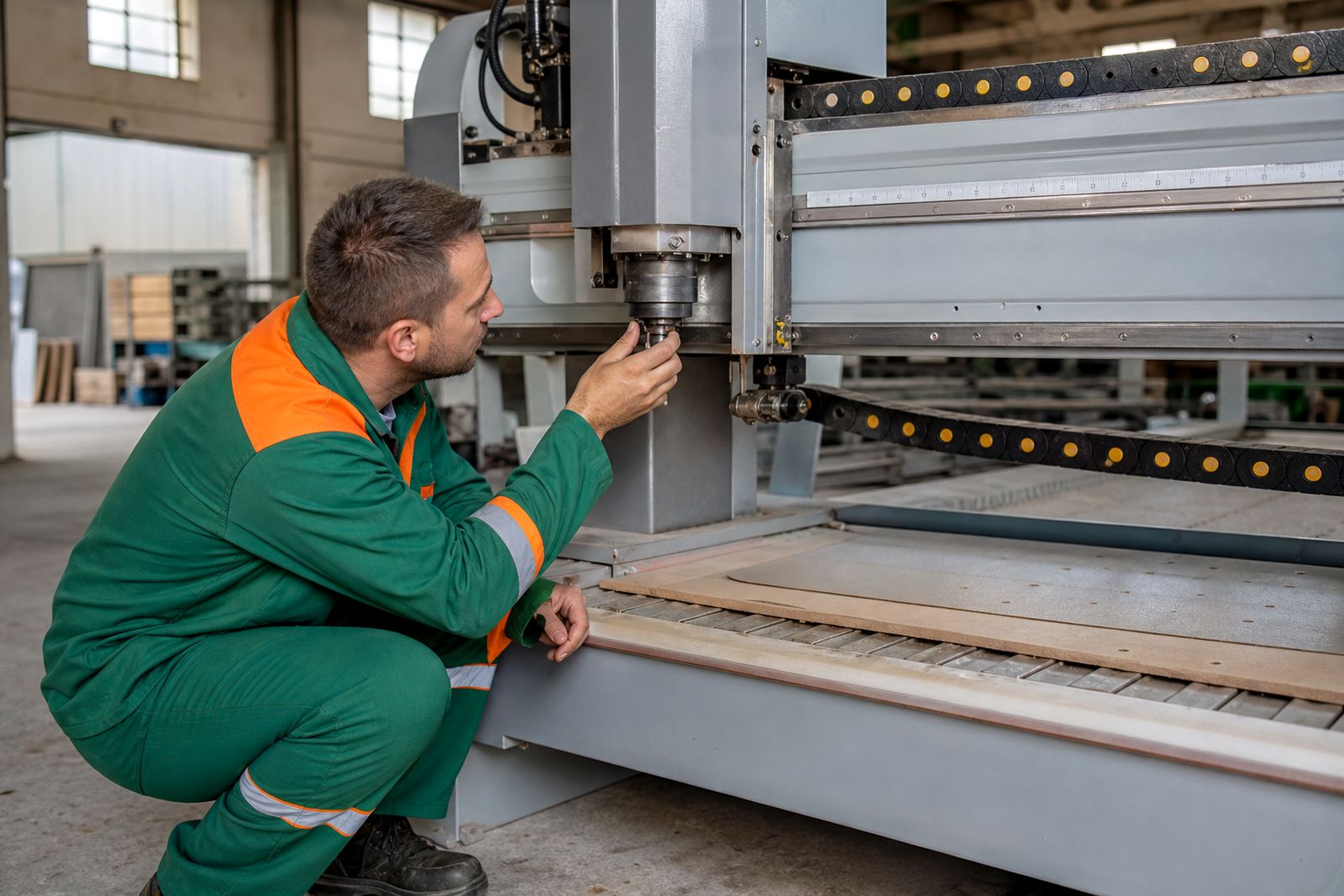
Router faults we deal with on site
CNC routers fail in a few familiar ways, and proper diagnosis usually needs a full machine check. A spindle alarm may start with heat, worn bearings, a cooling problem, damaged cabling or a drive setting drift after previous work. Lost steps on X, Y or Z can point to mechanical drag, encoder trouble, a failing drive, contamination on rails, poor earthing or a weak power section. We test the machine as a system and replace parts only where the fault has been confirmed.
Most call-outs involve a mix of electrical and mechanical checks. On vacuum-bed routers we also inspect leaks around zones, pumps, pipe joints and spoilboard condition because hold-down trouble can look like a cutting issue at first. If the router is fitted with tool length setting, auto lubrication, extraction interlocks or safety light barriers, those get checked as part of the fault path where relevant.
- Spindle trips, overheating, noise, poor start-up and unstable speed
- Servo and stepper drive faults, following errors and axis drift
- Vacuum pump, zone valve and hold-down faults on nested-based work
- Limit switch, homing, sensor and cable chain faults
- Z-axis crashes, depth inconsistency and position loss between sheets
- Controller, HMI, I/O and communication faults
- Lubrication, rail, ball screw and rack wear checks
What is included in a CNC router repair visit
A repair visit starts with fault-finding at the machine, followed by practical repair work that can be done safely on site. Where a failed item needs replacement, we identify the part, check fitment details and install or source the nearest correct match that suits the machine's control and load requirements. The job closes with functional testing and a service report that records the work carried out and any further concerns found during the visit.
We do not sell new routers. Our work is centred on keeping existing routers running, improving reliability where repeated faults are costing production time and advising when a retrofit makes more sense than repeated patch repairs.
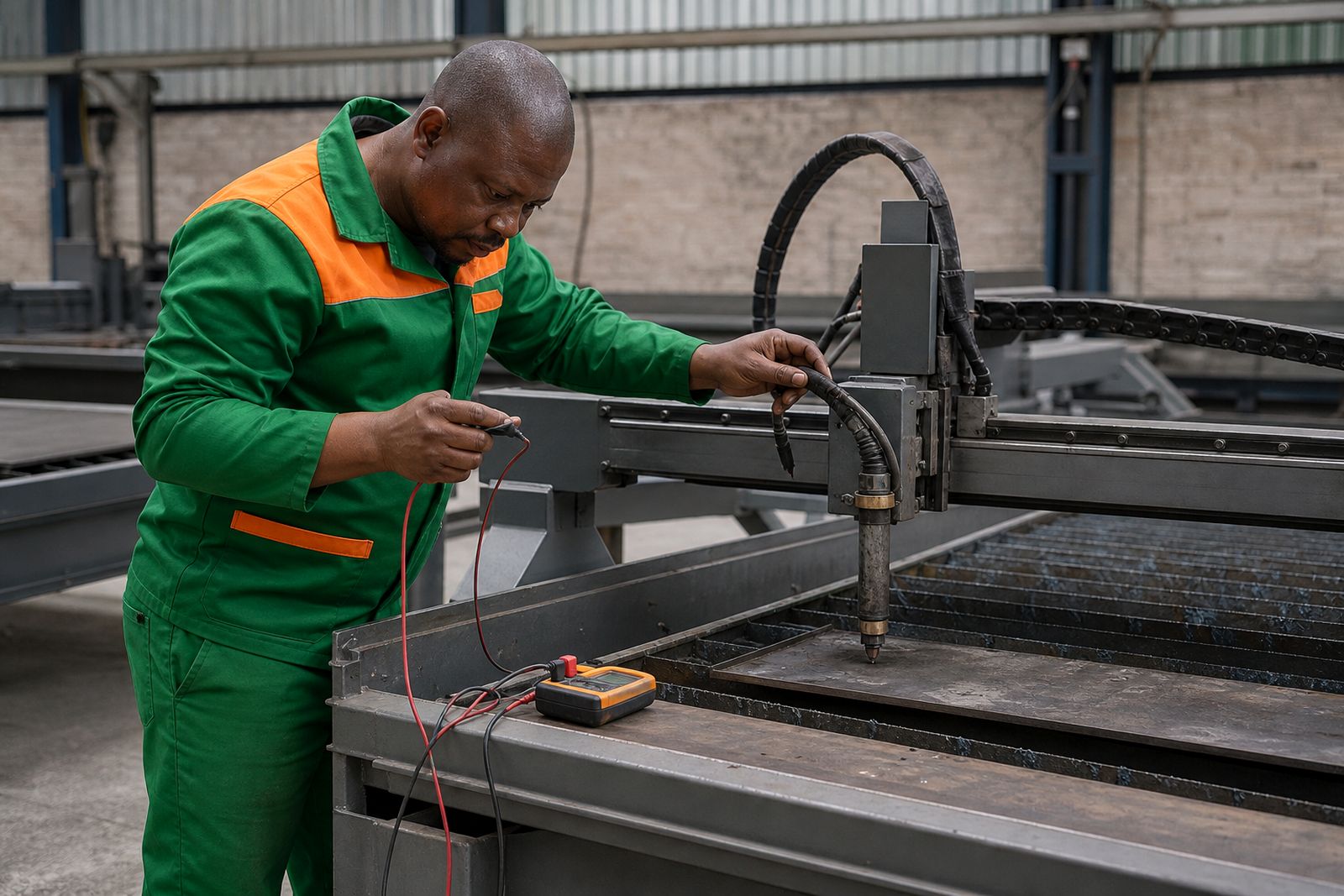
- On-site diagnostics with meter testing and live fault tracing
- Mechanical inspection of rails, bearings, couplings, rack, pinion and screws
- Drive, spindle and control cabinet checks including cooling and dust ingress
- Replacement of failed service parts where available and suitable
- Parameter checks after drive or control component work
- Basic cut test, movement test or vacuum hold test after repair
- Written service report for maintenance records
How the job runs from booking to report
Clients log the machine details through our contact form, including the town, machine type, controller type if known and a short note on the fault. If there are alarm photos, a panel picture or a short clip showing the problem, those help narrow the first checks. For factories with several routers or linked extraction and vacuum equipment, it helps to mention whether one machine is down or whether the fault appears across the line.
Once booked, the field technician attends site with test equipment and common service stock. The first stage is to verify the fault under controlled conditions, then isolate whether the cause sits in the spindle circuit, axis drive train, vacuum system, control cabinet, machine mechanics or the incoming supply. Repairs on site are done first where practical. If a component has to be removed for bench assessment or a special part has to be sourced, the service report notes the next required step and the machine is left in a safe state.
After repair, we run through homing, axis travel, interlocks and a sample movement or cut sequence where site conditions allow. That last check matters because a router can power up normally and still fail once the spindle loads up or the gantry reaches full travel.
What to prepare before the technician arrives
A router repair goes better when the machine can be inspected without clearing piles of board, offcuts and packaging around it. Please keep access open to the control cabinet, vacuum plant, spindle area and the full axis travel where possible. If the fault only shows under certain material sizes or specific tooling, leave one example ready so the same conditions can be checked during the visit.
Where a router shares power, extraction or compressed air with other equipment, site staff should point that out early. On some premises the real fault sits upstream, especially after electrical work in the building or repeated nuisance trips during load-shedding changeovers and generator use.
- Machine make and model, if known
- Controller or operator panel type, if visible
- Alarm text, fault code or description of the symptom
- Material being cut, cutter size and spindle speed if relevant
- Whether the problem is constant or only after warm-up
- Access to isolators, vacuum pumps and any linked extraction plant
- A staff member who knows the machine's recent behaviour
How pricing is worked out
Router repair pricing depends on travel, time on site, the difficulty of the fault and the parts needed. A straightforward sensor or cable issue is priced very differently from a spindle circuit failure, a servo replacement or a vacuum fault that requires work across the bed, pump and valve network. Multi-machine sites can also need a broader inspection because one fault may be linked to shared power quality, dust contamination or common control settings.
We normally separate the job into call-out or travel, labour, parts and any extra work approved after diagnosis. If a router needs follow-up work such as spindle replacement, drive matching, rail correction or control retrofits, that is itemised so the client can weigh repair cost against machine age and production demand. There is no point hiding a tired mechanical base under a neat electrical repair if accuracy is already out by several millimetres across the bed.
Aftercare, maintenance and when retrofits make sense
Each completed job ends with a service report covering the fault found, work done, parts fitted and any risks still present. That report helps maintenance teams track repeat failures like overheating in the cabinet, dust ingress around drives, loose earthing points or vacuum leaks that keep returning after spoilboard changes. For plants running routers daily, planned service visits are usually cheaper than emergency stoppages and wasted board.
Where the original control hardware has become unstable, parts are scarce or performance no longer suits the work, retrofit options can be assessed. That may involve updated drives, control hardware, spindle interface work, safety circuit clean-up or replacement of worn feedback devices. The right point for a retrofit is usually when the machine frame and motion components are still worth keeping but the electrical side is turning into repeated downtime. That is a common pattern on heavily used routers.
What our CNC Repair customers say
Verified Google reviews
Questions we get asked
Do you work on older CNC routers?
We work on many older routers where parts can still be repaired, matched or sensibly replaced. The first step is to inspect the control system, drive setup and mechanical wear before deciding whether repair or retrofit is the better route.
Can you fix vacuum hold-down problems as well as electrical faults?
Vacuum trouble is often part of the same production problem, so we check pumps, leaks, valves, piping and spoilboard condition alongside the machine fault where needed.
Do you only service routers in Gauteng?
Our base is in Midrand, and field technicians cover Gauteng, KwaZulu-Natal, the Western Cape, the Eastern Cape, the Free State and the rest of South Africa.
Also worth a look
Tell us about the job
Send sizes, materials and where you are through our contact form, and we will come back with the practical options.
Open the contact form