Retrofits and upgrades
When a machine frame is still straight and the motion hardware can be saved, a retrofit often makes more sense than replacing the whole unit. CNC Repair handles control, drive and spindle upgrades on working machines across South Africa, with testing and a written service report at the end.
When a retrofit is the right call
Some machines reach a point where repeat faults, obsolete electronics or unstable motion start affecting production every week. If the base frame, rails, gantry, table and guarding are still serviceable, a retrofit can return the machine to dependable work without changing the whole installation.
Our team works on CNC routers, CO2 and fibre lasers, plasma cutters, milling machines, plotters, cutting tables, wide-format printers and vinyl cutters. We are independent and we repair and maintain machines of many makes. We focus on retrofit work on existing machines, so the job is assessed on condition, parts availability and whether the upgrade will solve the actual fault path.
- Control replacement where the original interface, I/O or software support has become a problem
- Drive upgrades for unstable axis movement, alarm faults or poor speed control
- Spindle replacement where noise, bearing wear or heat is affecting cut quality
- Encoder, motor and wiring work linked to axis feedback problems
- Safety circuit tidy-up where interlocks, e-stops or limit chains need to be restored
What is included on a retrofit job
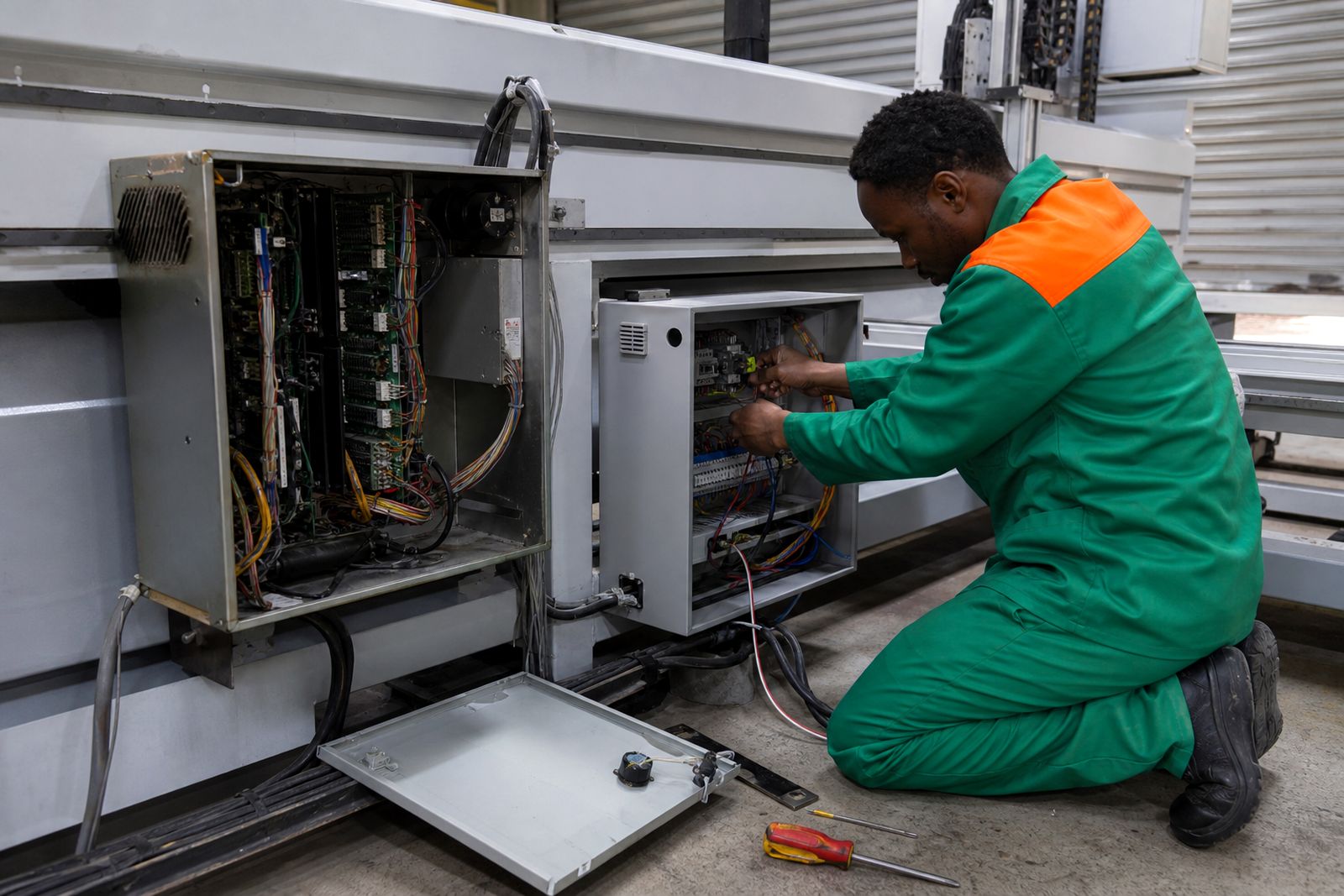
A retrofit starts with fault-finding on the machine in its current state. We inspect the electrical cabinet, drives, control hardware, spindle system, cooling arrangement, cable routing, sensors and field wiring. Mechanical wear is checked as well, because new electronics cannot correct backlash from worn screws, loose couplings or damaged linear bearings.
Once the machine condition is clear, we scope the conversion around the parts that must be changed and the sections that can stay in service. The work can include removal of failed controls, installation of replacement drives, spindle setup, parameter loading, I/O mapping, homing configuration, test cuts and report writing. On laser and plasma equipment we also check the support systems tied to motion and firing, as these often cause the fault chain people miss at first.
- Strip-out of failed or unsuitable electronic assemblies
- Supply and fitment of compatible control and drive components
- Cabinet rework, labelled wiring and terminal clean-up
- Axis tuning, direction checks and travel limit verification
- Spindle testing under load where the machine type allows it
- Service report listing findings, parts fitted and follow-up items
How the retrofit moves from inspection to handover
The first step is an on-site assessment. We record the machine type, axis count, table size, installed spindle power, control symptoms, alarm history and any previous repair work. Photographs of the cabinet and motion assemblies help us match parts and decide whether a staged retrofit is better than a single shutdown.
After that we prepare a scope for the parts and labour needed. If a machine has secondary issues such as worn drag chains, coolant leaks, extraction faults or damaged limit wiring, those are noted separately so the client can see what forms part of the retrofit and what sits outside it.
Installation is then scheduled around site access and production stoppage. Old hardware is removed, replacement units are mounted, wiring is checked point by point, and the machine is powered up in a controlled sequence. Parameters are loaded, axis travel is confirmed and safety functions are tested before any production work starts. Final handover includes test running and a written report, though sometimes a snags list remains for items outside the approved scope.
What to prepare before our field technicians arrive
A retrofit runs better when the machine and work area are ready for inspection and strip-down. Clear access around the cabinet, rear service side and gantry ends saves time, especially on large routers and cutting tables. If the machine has had repeated power trips or environmental problems, note those down before the visit because they matter during diagnosis.
- Machine model, serial plate details and the current control fault message if visible
- Photos of the cabinet, operator panel and damaged components where possible
- Any manuals, parameter backups or old service notes still on site
- Safe access, isolation point and enough floor space for panels and removed parts
- Material for a test run if cut quality or registration must be checked
Where a machine sits in a humid coastal workshop, cabinet contamination and connector corrosion can affect the outcome more than expected. In inland shops around Midrand, dust loading and unstable three-phase supply are often the bigger issue, so it helps if site maintenance can confirm recent power conditions.
How pricing is worked out
Retrofit pricing depends on machine size, axis configuration, spindle rating, cabinet condition and the extent of rewiring needed. A small vinyl cutter or plotter upgrade is a very different exercise from a large router with multiple drives and a high-power spindle. Travel, access difficulty and whether the job needs staged commissioning also affect cost.
The price is built from inspection time, replacement parts, fabrication or panel work where needed, installation labour, tuning, testing and travel for field attendance. If a machine needs related mechanical work before the new controls can be commissioned properly, that is listed separately. We price against the actual machine condition and scope on site, which helps prevent nasty surprises later.
Aftercare and follow-up on the upgraded machine
Once the retrofit is complete, we leave a service report with the fitted parts, core settings recorded during commissioning and notes on any remaining wear items. Operators and maintenance staff are shown the practical points that matter on that machine, such as startup order, warm-up, homing behaviour, alarm reset sequence and the checks to make before a long production run.
Retrofit work often leads into a planned maintenance arrangement, especially on machines that carry daily production. That can include periodic axis checks, spindle inspection, cabinet cleaning, fan and filter replacement, backup verification and fault tracing if a new issue appears later. For machines running across multiple branches, we can align the service record format so each site keeps the same maintenance trail through our contact form and field reports.
What our CNC Repair customers say
Verified Google reviews
Questions we get asked
Can you retrofit only the control and keep the existing motors?
Suitable motors, feedback devices and mechanical parts can be retained. We check compatibility first, then scope the job around what can be kept safely and what must be replaced.
Do you work on imported machines with limited local support?
We are independent and we repair and maintain machines of many makes. The practical limit is parts availability and whether the machine condition justifies the upgrade.
Will the machine need to leave our premises?
Most retrofit work is handled on site. If a sub-assembly needs bench work or there is major panel rebuilding, we note that in the scope before the job proceeds.
Also worth a look

Tell us about the job
Send sizes, materials and where you are through our contact form, and we will come back with the practical options.
Open the contact form